140
The Concept Fallacy
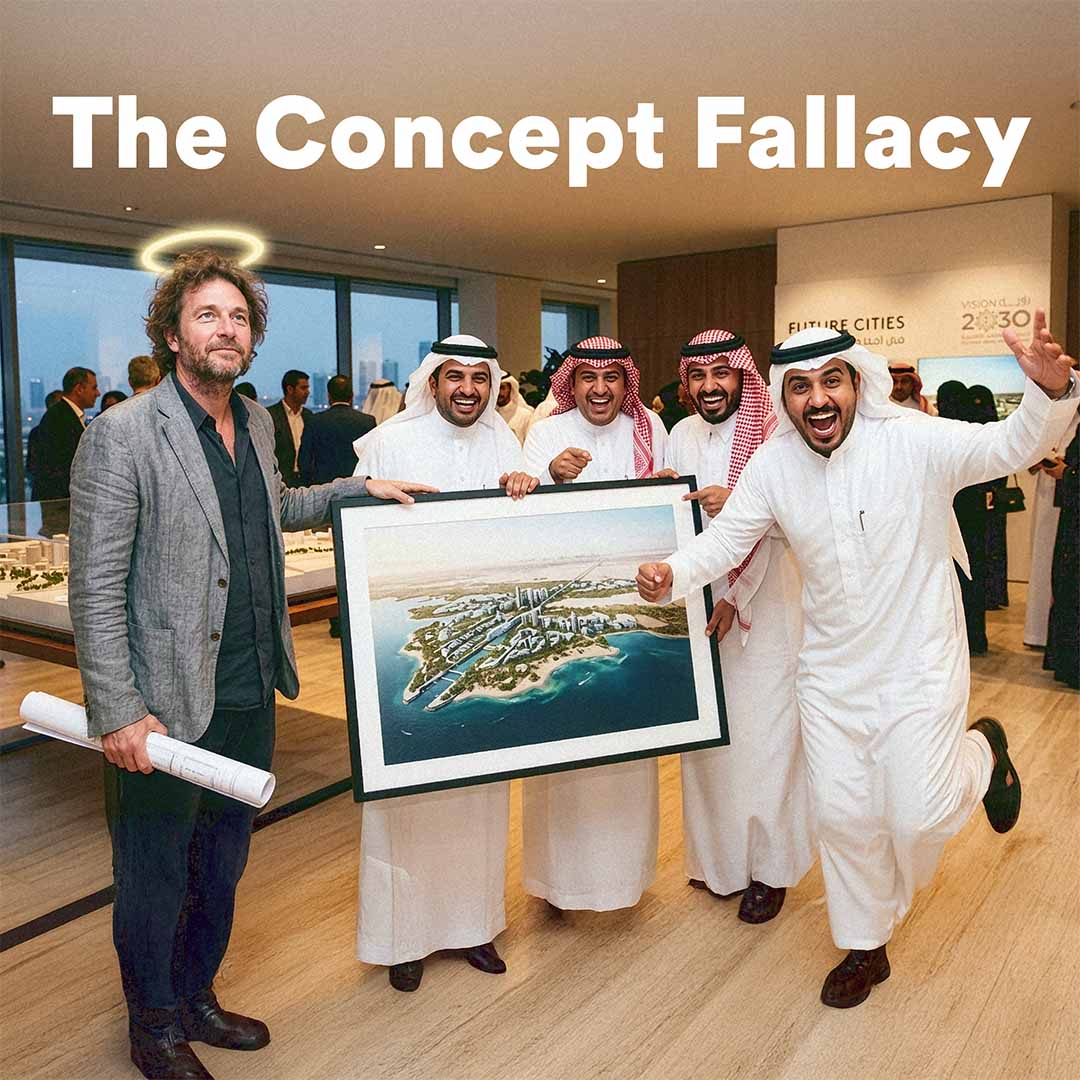
The separation of Concept Design into a standalone project phase has created a distortion within the development process.
Increasingly, Concept Design is treated as a discrete deliverable, often undertaken by specialist consultants whose involvement ends before design development and construction begin. International practices are commissioned to produce visionary schemes and compelling narratives, before responsibility passes to others tasked with making the project viable, buildable and operational.
This model rewards novelty over rigour.
The profession has become increasingly preoccupied with the unprecedented. Yet many things have not been done before because they are impractical, inefficient, uneconomic or contrary to human behaviour. The removal of technical constraints, or the availability of capital, does not justify a proposition. The ability to do something is not an argument for doing it.
Projects that endure rarely pursue innovation as an end. They succeed because they respond to genuine human, cultural or economic needs. Diriyah derives its strength from a deep connection to place, history and identity. KAFD addresses a clear commercial and institutional demand.
By contrast, standalone concepts can become exercises in self-referential logic. Their value is assumed because they are different. Their success is measured by novelty rather than performance.
NEOM's The Line illustrates this dilemma. Its engineering ambition is extraordinary, but the proposition remains at odds with the way cities have historically evolved. Human settlements tend towards radial and interconnected forms that reflect movement, accessibility, social interaction and economic exchange. A highly internalised linear city may be technically achievable, but that does not automatically make it desirable or sustainable.
Concepts are not valuable because they are ambitious, expensive or unprecedented. They are valuable when they solve real problems, improve lives and deliver outcomes that can be demonstrated rather than imagined.
Architecture is ultimately a practical discipline. It is judged not by the persuasiveness of a rendering, but by the quality of the places it creates and the lives it supports.
Many of the world's most successful buildings, districts and cities are neither radical nor revolutionary. They simply respond exceptionally well to human needs.
Practicality is not the enemy of progress. It is often the foundation of it.