131
Presence and Absence
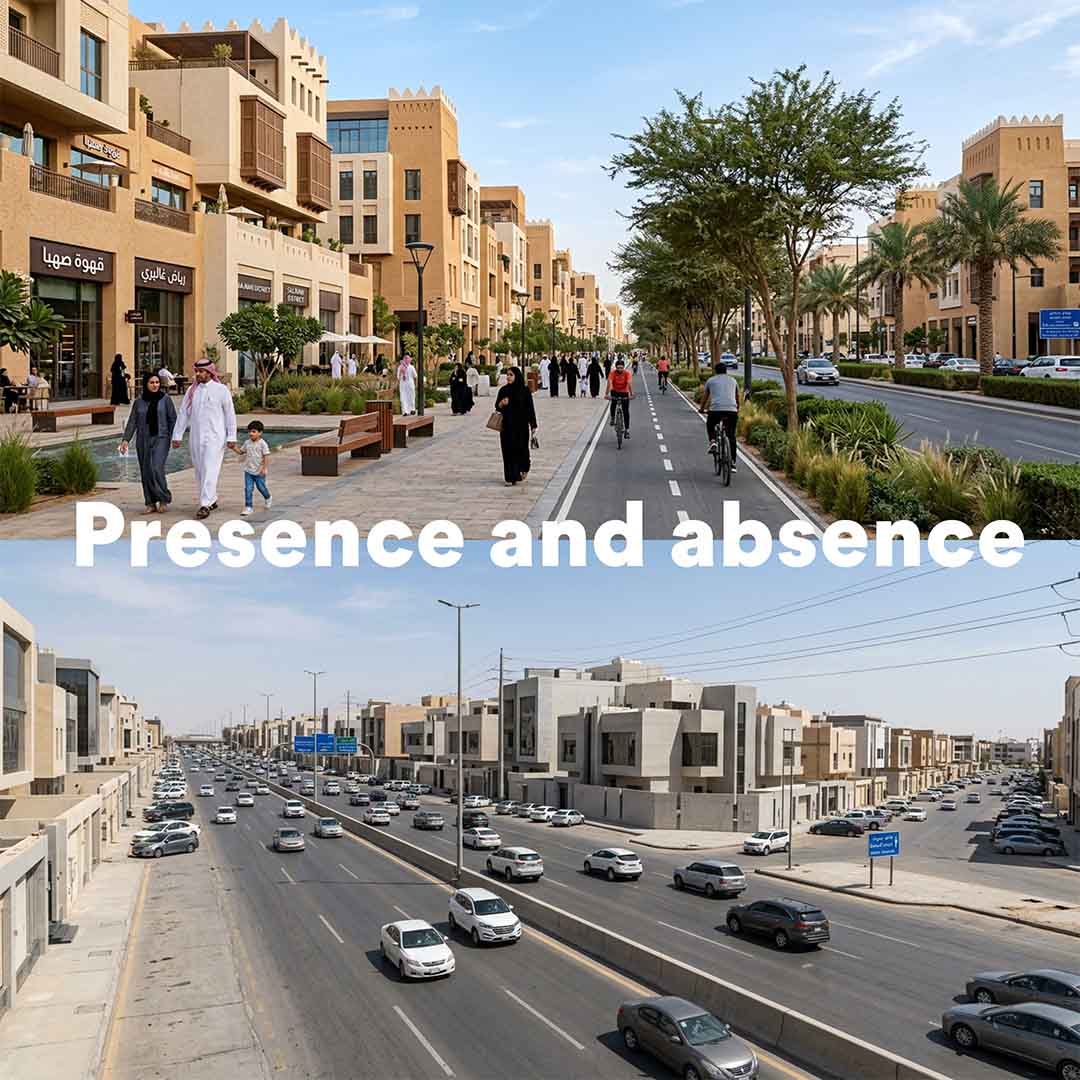
Across much of the Middle East today, we are seeing two parallel conditions emerge in architecture and urbanism: presence and absence.
Presence is architecture that belongs to its context. Buildings and urban spaces shaped by climate, culture, social customs and patterns of use. It is the courtyard that moderates heat while creating shared space. The narrow street that provides shade and encourages walkability. The mashrabiya filtering light and maintaining privacy. The majlis, the sikkas, the thresholds between public and private life. These are not decorative references to heritage – they are spatial responses refined over centuries to support both environmental performance and social structure.
Absence, by contrast, is the increasing ubiquity of placeless international modernism. Generic glass façades, isolated towers, deep floorplates dependent on mechanical conditioning. Urbanism which is designed primarily around vehicles rather than pedestrians. Buildings that could be located almost anywhere and therefore contribute little to local identity or urban specificity.
The issue is not modernity itself. The Middle East has always absorbed external influences and adapted them. The concern is what happens when architecture loses its climatic and cultural intelligence in the process.
At a social level, this has significant implications.
When architecture responds to local patterns of life, cities tend to support greater levels of public interaction and accessibility. Streets function as social infrastructure rather than simply circulation routes. Daily life becomes less dependent on the car. Informal gathering spaces emerge naturally within the urban fabric rather than requiring dedicated destinations.
When that presence disappears, urban environments become more fragmented and transactional. Social interaction shifts into controlled environments. Public space loses utility. Development is driven more by image and standardisation than by long-term civic performance.
There is also an important question of value.
For many years, value in development has been measured through metrics such as efficiency, speed, height, density and visual impact. Increasingly, however, long-term value depends more on resilience, adaptability, walkability, environmental performance and cultural relevance.
Places with genuine presence tend to remain useful over time because they are fundamentally aligned with how people live and with the environmental realities of their region.
The future of architecture in the Middle East is not a choice between tradition and progress, but about reconnecting contemporary development with the intelligence already embedded within the region’s urban history.