

121
Planned Communities – 5
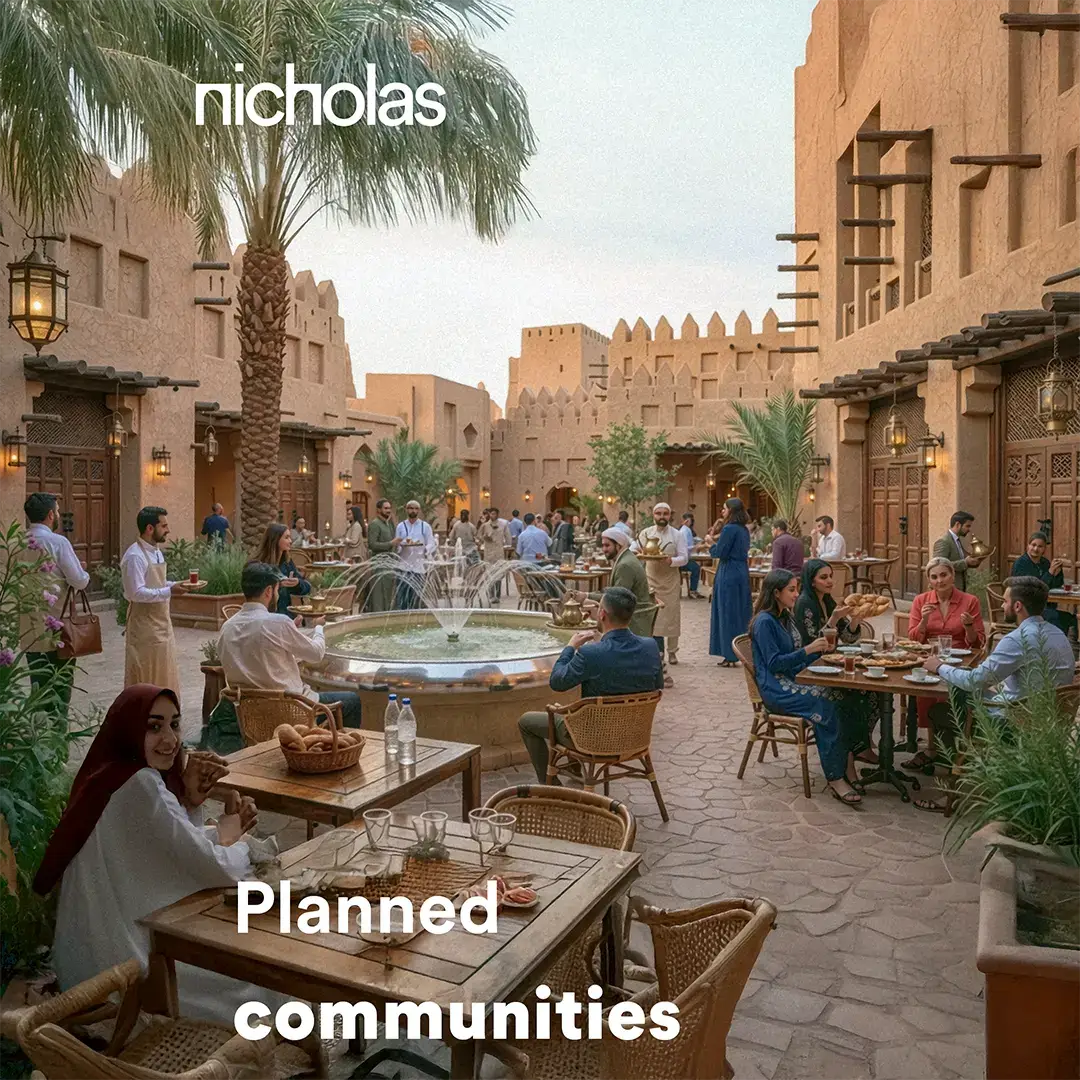
The civic courtyard is one of the oldest urban instruments we have. Long before mixed-use was a planning category, it was simply how people lived: an (often shaded) shared space.
In Riyadh's emerging communities, Najdi principles offer more than aesthetic reference. Proportion, enclosure, and microclimatic performance are structural decisions that determine whether a place invites people to linger or drives them indoors. The courtyard becomes the connective tissue of a walkable urban system.
What this framework demonstrates is that cultural grounding and operational efficiency are not competing values. They reinforce one another. A city that draws on its own spatial memory creates more than buildings. It fosters continuity.
In Riyadh’s emerging communities, we are envision a network of civic courtyards that support a more walkable and integrated urban experience. The approach is informed by Najdi architectural principles – particularly proportion, shading, and spatial sequencing – reinterpreted for contemporary city-making.
Rather than standalone public spaces, these courtyards function as part of a cohesive mixed-use system. Residential, retail, and leisure uses are deliberately integrated within short walking distances to reduce car dependency and encourage everyday pedestrian activity.
This structure supports a more continuous public realm, where movement, pause, and social interaction are embedded into daily patterns of use rather than concentrated at isolated destinations.
Given Riyadh’s climate, environmental performance is central to this strategy. Shade, enclosure, and microclimatic comfort – principles long established in Najdi urban form – are applied as fundamental design drivers, not aesthetic references.
The result is a resilient urban framework: a connected system of spaces that is both culturally grounded and operationally efficient, designed to support long-term civic and economic activity.