

120
Planned Communities – 4
Some of the best climate solutions were devised centuries ago: courtyards, shaded streets, fountains at the centre of a square. Builders in Saudi Arabia had no air conditioning, only observation and time.
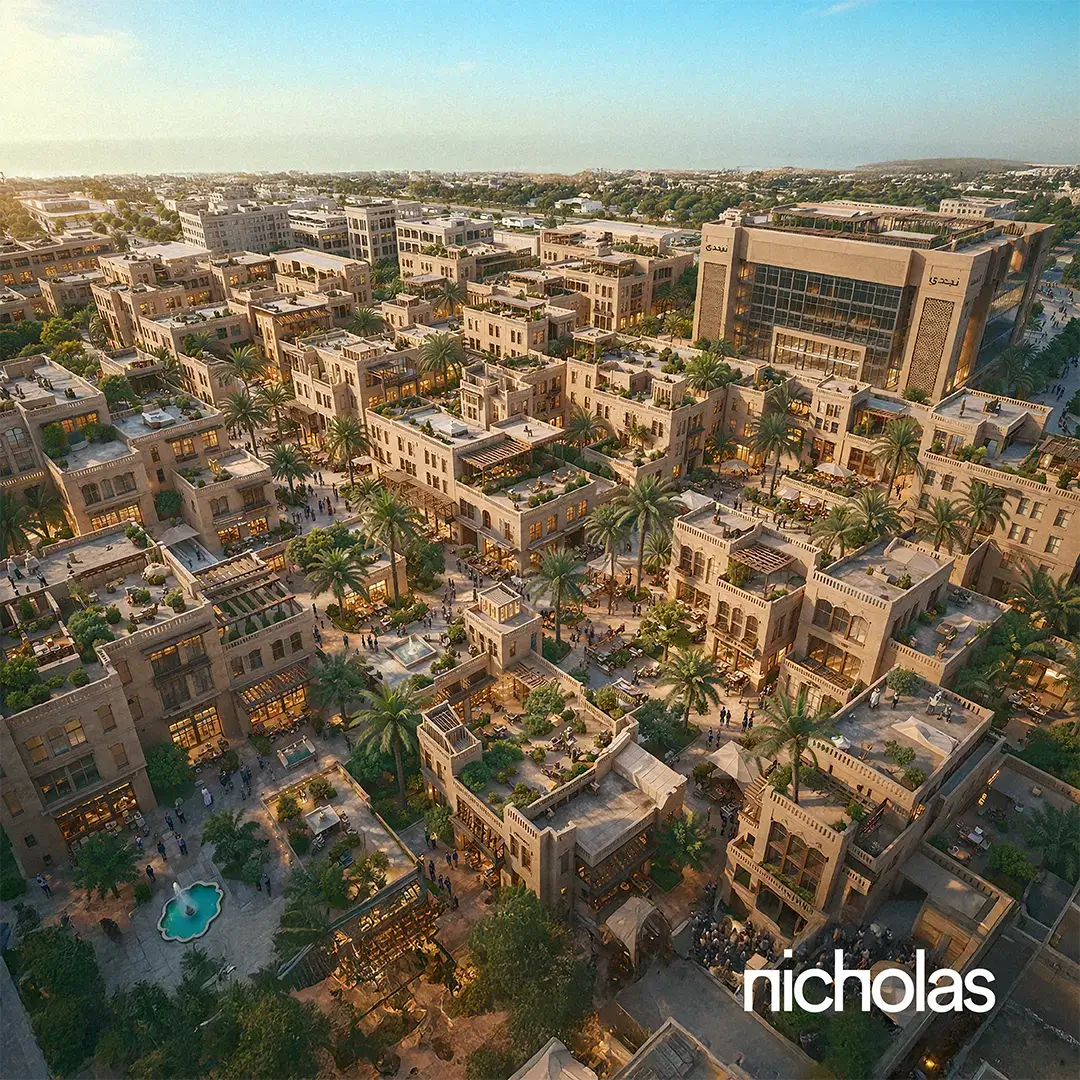
Today, neighbourhoods in Riyadh are returning to the principles of Najdi architecture. Compact courtyards – with colonnades – reduce heat gain in buildings, shaded walkways lower the perceived temperature, and water features regulate the microclimate while bringing social spaces together.
Modern cities often import design models from entirely different latitudes. Glass skyscrapers in 45-degree heat do not necessarily represent progress.
Traditional architecture had the answers before anyone thought to ask the questions.
At nicholas, we approach urban design in the Middle East as a synthesis of climate intelligence, cultural continuity, and long-term development value. In cities like Riyadh, successful master planning is not imported – it is grounded in place.
Our mixed-use designs draw from Najdi architectural principles to shape a walkable, human-centric urban environment. Courtyards, shaded streets, and water features are not stylistic gestures; they are proven environmental strategies that reduce heat gain, enhance comfort, and support social interaction.
By aligning massing, materiality, and public realm design with local climate conditions, we create cooler, more resilient communities that perform at both human and urban scales.
For developers and stakeholders across Saudi Arabia and the wider Middle East, this approach delivers more than identity – it drives liveability, differentiation, and long-term asset value.
As architects and urban designers, we see culturally grounded, climate-responsive design not as an option, but as the foundation of future-ready cities in the region.